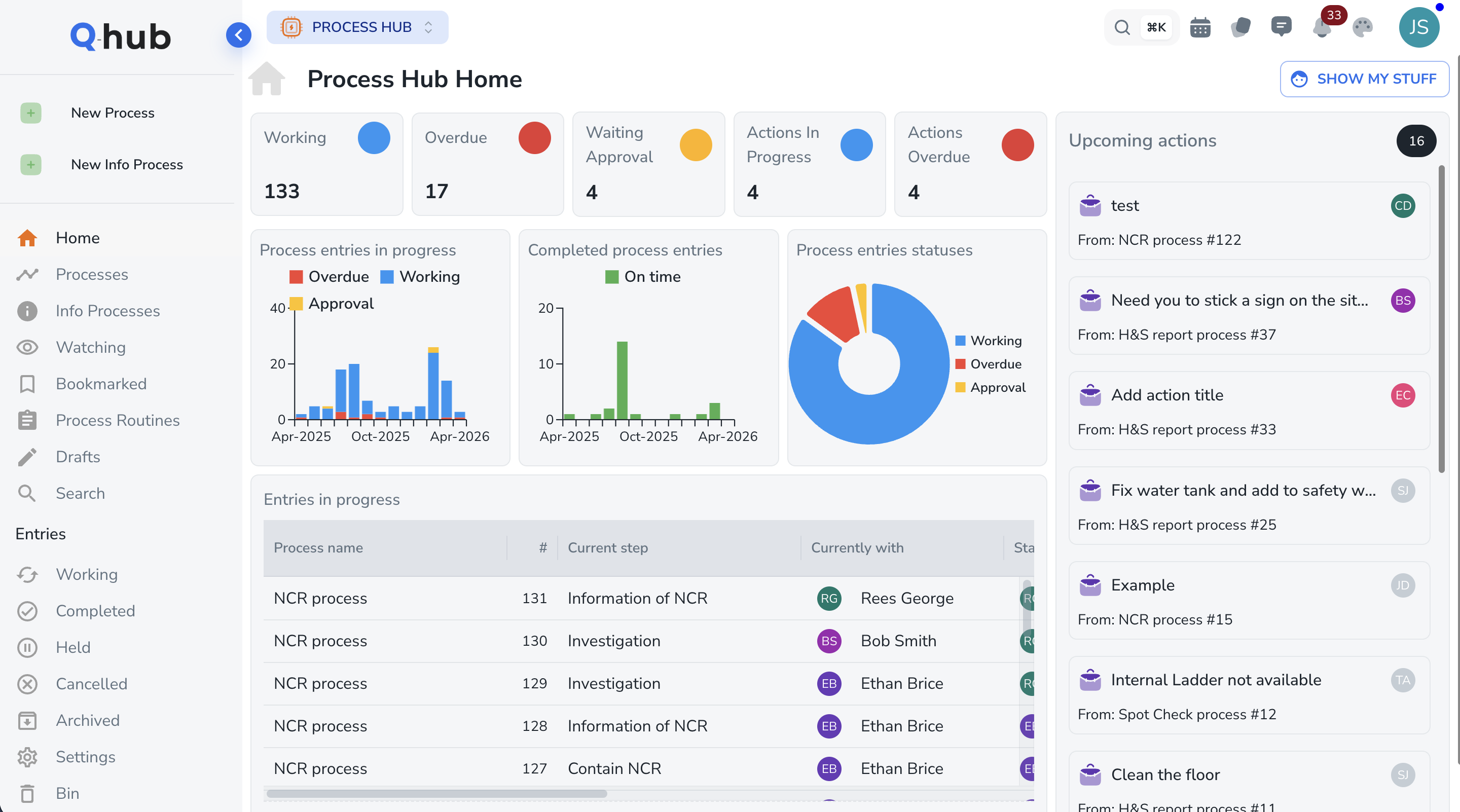
Achieve ISO 45001 certification — occupational health & safety management
Map every clause of ISO 45001:2018 to your OH&S management system. Risk assessments, incident reporting, safety observations, contractor and site management, training matrices, and audit scheduling — all in one platform.







Operational controls that protect your people
ISO 45001 requires you to plan and control operations to eliminate hazards and reduce OH&S risks. Q-Hub provides contractor and site management, method statement management, contractor pre-qualification, and emergency preparedness plans — all linked back to your risk assessments so controls are always proportionate to the hazard.
- Contractor and site management with real-time status tracking
- Method statements linked to risk assessments
- Contractor pre-qualification and site induction tracking
- Emergency preparedness and response plan management
How Q-Hub maps to ISO 45001 requirements
| Feature | Clause | Requirement | Q-Hub Coverage | Q-Hub |
|---|---|---|---|---|
| 4. OH&S Context | Understand internal/external OH&S issues and interested parties | Risk Register, stakeholder analysis templates, scope documentation | ✓ | |
| 5. Worker Participation | Leadership commitment, worker consultation and participation | Safety observations, suggestion tracking, role-based access | ✓ | |
| 6. OH&S Risks & Opportunities | Hazard identification, risk assessment, legal requirements | Risk Assessment module, legal register, OH&S objectives tracking | ✓ | |
| 7. Competence & Awareness | Competence, awareness, communication, documented info | Training matrices, competency tracking, Document Control | ✓ | |
| 8. Operational Control | Eliminating hazards, hierarchy of controls, emergency preparedness | Contractor and site management, emergency plans, method statements | ✓ | |
| 9. Monitoring & Audit | Monitoring, incident investigation, internal audit, management review | Audit scheduling, incident investigation workflows, KPI dashboards | ✓ | |
| 10. Improvement | Incident/nonconformity response, continual improvement | Incident reporting, CAPA management, trend analysis | ✓ |
Trusted by compliance teams worldwide
“Qhub provides a visible, intuitive way to manage data and workflows, revolutionising our approach to operations”

Fowlers of Bristol (Engineers) Ltd
Operations director
“Qhub helps us to... proactively use our QMS... and increase efficiency”
Anglia Cathodic Protection Services
Business manager
“Really made a difference with providing compliance during audits – both regulatory, customer, and internal.”

Auxitrol Weston
Quality manager
“QHub has supported us in achieving a higher compliance rate.”
BMC Analysis
Technical Manager/ Quality Manage
“We can't believe how fast we were able to get it up and running.”

Cawood Group
“Managing NCRs are now so much easier”

Enviromesh
Quality manager
“Where was this 2 years ago... we're blown away”

Jaltek
Compliance manager for Jaltek
“Qhub has improved our safety management system no end, making it very efficient”

Rocal Endurance Doors
Compliance manager
“We use it for as much as possible.”

Scottish Leather Group
Compliance manager
ISO 45001 FAQs
ISO 45001 replaced OHSAS 18001 in March 2021. Key differences include the Annex SL high-level structure for easier integration with ISO 9001 and ISO 14001, stronger requirements for leadership commitment and worker participation, explicit requirements for managing risks and opportunities, and a broader view of "interested parties" beyond just employees. If you were certified to OHSAS 18001, you must have transitioned to ISO 45001 to maintain certification.
ISO 45001 Clause 5.4 requires organisations to establish processes for worker consultation and participation. Q-Hub supports this through mobile safety observation submissions, anonymous near miss reporting, toolbox talk attendance records, safety committee meeting minutes with action tracking, and employee suggestion workflows. All participation is recorded and auditable, providing the evidence that certification bodies look for.
ISO 45001 Clause 6.1 requires organisations to identify hazards, assess OH&S risks and opportunities, and determine applicable legal requirements. Q-Hub provides structured risk assessment templates with severity and likelihood matrices, hierarchy of controls tracking, automatic review dates, and linkage to specific job roles and locations. Risk assessments are version-controlled and linked to incidents so you can demonstrate that assessments are reviewed when circumstances change.
Q-Hub makes near miss reporting as frictionless as possible with mobile-first forms, QR code scan-to-report, photo and voice note capture, and optional anonymous submission. Reports automatically trigger investigation workflows, feed into trend dashboards, and link to risk assessments for review. Organisations using Q-Hub typically see a 5-10x increase in near miss submissions, which is a leading indicator of a mature safety culture.
Yes. Both ISO 45001 and ISO 9001 share the Annex SL high-level structure, making integration straightforward. Q-Hub manages both standards in a single platform with shared document control, audit scheduling, CAPA management, and training records. Common elements like management review and internal audit are managed once and mapped to both standards, reducing duplication and audit fatigue.
The timeline to ISO 45001 certification depends on your starting point, the complexity of your operations, and the number of sites. Q-Hub supports your certification journey by centralising risk assessments, incident records, training logs, and worker consultation evidence in one place. Organisations transitioning from OHSAS 18001 or already certified to ISO 9001 can often move faster as the management system foundations are already in place.
Your Data Is Safe With Us
Hover to learn about each certification and commitment.
Connects with the tools you already use
Q-Hub connects to your existing tools via REST API, webhooks and SSO, with bespoke connectors on request. More integrations coming soon.
Ready to protect your people and achieve ISO 45001?
See how Q-Hub maps to every clause of ISO 45001 and supports your certification journey.
What is ISO 45001?
ISO 45001:2018 is the international standard for occupational health and safety management systems. It replaced OHSAS 18001 in March 2021 and provides a framework for organisations to proactively prevent work-related injury, ill health, and fatalities. The standard places particular emphasis on worker participation and consultation at every level. Built on the Annex SL high-level structure shared with ISO 9001 and ISO 14001, the standard follows a Plan-Do-Check-Act cycle and requires organisations to identify OH&S hazards, assess risks and opportunities, establish controls, and drive continual improvement. Certification is awarded by UKAS-accredited bodies following successful Stage 1 and Stage 2 audits.
Be safety-audit-ready every day, not just before the assessor arrives
Hazard identification and risk assessment Structured risk assessments with severity/likelihood matrices, hierarchy of controls, and automatic review scheduling. Every hazard documented and tracked to closure. Near miss and incident reporting Mobile-first reporting for incidents, near misses, and safety observations. Record and track reportable incidents, with investigation workflows and CAPA triggers — all with full audit trail. Worker consultation evidence Demonstrate worker participation through safety observations, toolbox talk records, safety committee minutes, and suggestion tracking — the evidence auditors specifically look for.
Hazard identification and risk assessment
Hazard identification and risk assessment Structured risk assessments with severity/likelihood matrices, hierarchy of controls, and automatic review scheduling. Every hazard documented and tracked to closure.
Your ISO 45001 certification journey with Q-Hub
We assess your current safety management against ISO 45001 requirements, identify gaps, and configure Q-Hub to address them. Risk assessments, incident reporting, contractor and site management, training matrices, and audit schedules configured and tested. Your team uses Q-Hub for daily safety management. Near miss reports, safety observations, and toolbox talks build the evidence base auditors require. External auditor accesses evidence directly in Q-Hub. Risk assessments, incident records, training logs, and worker consultation evidence all in one place.
OH&S gap analysis
System setup
Implementation and evidence
Certification audit
Turn every incident into a safety improvement
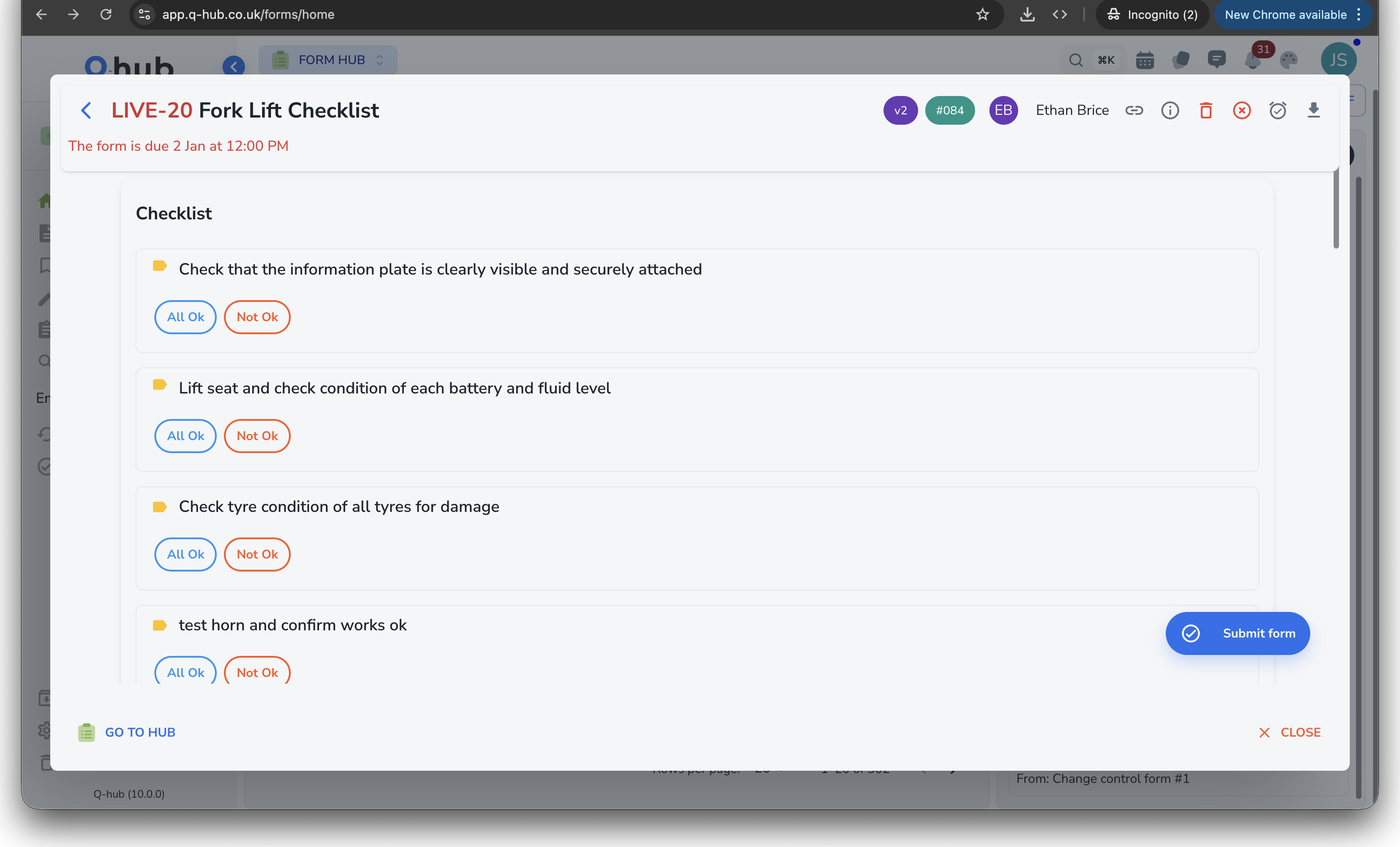
ISO 45001 demands you investigate incidents, determine root causes, take corrective action, and verify effectiveness. Q-Hub automates the full cycle: incident reported on mobile, investigation assigned, root cause analysis completed, CAPA raised, action tracked, effectiveness verified. Near miss trends surface systemic risks before they become injuries.
- Structured incident investigation with root cause tools
- Automated CAPA assignment with escalation rules
- Near miss trend analysis and leading indicator dashboards
- Record and track reportable incidents and statutory reports