
AS9100D compliance made airworthy: control documents, parts and audits in one place
Q-Hub gives aerospace and defence manufacturers a single system for configuration control, first article inspection, counterfeit-parts prevention and audit-ready evidence.
Get AS9100D certification-ready faster
See how aerospace manufacturers use Q-Hub to control configuration, evidence first article inspections and close nonconformances before the auditor arrives.
See PricingNo credit card required · 30-day free trial · Live in 4 weeks
What is AS9100?
AS9100 is the internationally recognised quality management standard for the aviation, space and defence industries. Its current revision, AS9100D, is built directly on ISO 9001:2015 and adds around 100 aerospace-specific requirements covering configuration management, first article inspection, counterfeit-part prevention, product safety and special-process control. It is published by the International Aerospace Quality Group (IAQG) and applies to any organisation that designs, manufactures or maintains aerospace products, from prime contractors to sub-tier suppliers.
Certification is granted by an accredited certification body and every certified organisation and audit is recorded in the OASIS database. Auditors assess your quality management system against AS9100D over a two-stage initial audit, then verify continued conformity through annual surveillance and a three-yearly recertification. Aerospace audits are unusually evidence-heavy: assessors expect traceable records for configuration baselines, FAI reports, key characteristics, special-process approvals and corrective actions, so keeping that evidence current and retrievable is essential.
How Q-Hub maps to AS9100D clauses
Clauses 1 to 3 of the standard cover scope, normative references, and terms and definitions. The auditable requirements begin at clause 4, which is where this table starts.
| Clause | Requirement | How Q-Hub helps |
|---|---|---|
| Clause 4, Context of the organisation | Define the QMS scope and processes for the aerospace supply chain, including customer, statutory, regulatory and airworthiness authority requirements and interested parties. | Register Hub holds interested parties and regulatory obligations; Document Hub controls the scope statement, quality manual and process maps as version-controlled records. |
| Clause 5, Leadership, product safety & ethical behaviour | Demonstrate top-management commitment, assign responsibilities, and address AS9100 additions for product safety and prevention of counterfeit or unapproved parts. | Document Hub distributes the quality policy with read-and-understood sign-off; Register Hub tracks product-safety and counterfeit-parts risks with assigned owners and dashboards for management review. |
| Clause 6, Planning, risk & special processes | Plan actions to address risks and opportunities, set measurable quality objectives, and control operational risk including special processes and key characteristics. | Register Hub manages the risk and opportunity register with mitigation actions; Company KPIs track quality objectives live, and Register Hub flags special processes and key characteristics for control. |
| Clause 7, Support: competence, calibration & documented information | Provide resources, ensure competence and awareness, control monitoring and measuring equipment, and manage documented information with configuration and record retention rules. | Training Hub maintains competency matrices with certification-expiry alerts; Asset Hub schedules calibration and maintenance; Document Hub controls documented information with approval workflows and retention. |
| Clause 8, Operation: configuration management, FAI & counterfeit prevention | Control design and development, purchasing and external providers, production with configuration management, first article inspection (AS9102), counterfeit-part prevention and verification of product. | Document Hub manages configuration baselines and design records; Smart Forms capture FAI (AS9102) and inspection evidence with photos; Register Hub controls approved suppliers and counterfeit-parts checks; Audit Hub verifies received product. |
| Clause 9, Performance evaluation & internal audit | Monitor, measure and analyse the QMS, conduct internal audits, assess on-time delivery and quality performance, and hold management reviews. | Audit Hub schedules internal audits with aerospace checklists, findings and follow-up; Company KPIs report on-time-delivery and quality metrics; Document Hub holds management review minutes and inputs. |
| Clause 10, Improvement, nonconformance & corrective action | Manage nonconforming product, containment and disposition, drive corrective action to root cause, and pursue continual improvement of the QMS. | CAPA logs nonconformances and escapes, drives root-cause analysis and effectiveness checks; Smart Forms capture nonconformance reports on the shop floor with full traceability. |
Competitor pricing as published by each vendor. Figures marked ≈ are converted from the currency they were published in at today’s rate, for comparison only.
Walk into your AS9100 audit with evidence already in order
Aerospace assessors demand traceable, objective evidence for configuration, first article inspection, special processes and corrective action. Q-Hub keeps every record time-stamped, linked and instantly retrievable, so surveillance audits stop being a fire drill.
Configuration under control
Every design baseline, revision and controlled document is versioned in Document Hub with approval history, so you always show the auditor the current, correct configuration.
FAI evidence on demand
First article inspection reports (AS9102) captured in Smart Forms link characteristics to results and photos, so full first-article traceability is one click away.
Counterfeit parts screened
Register Hub records approved suppliers, certificates of conformity and counterfeit-part checks, giving auditors a clear line of defence for procured product.
Corrective action closed out
CAPA drives every nonconformance to documented root cause and effectiveness check, so no escape or finding is left open when the assessor reviews your records.
Configuration and document control built for aerospace rigour
AS9100 lives or dies on configuration integrity: the right revision, released, distributed and used. Document Hub controls every drawing, procedure, work instruction and quality record with enforced approval workflows, automatic version history and controlled distribution, so obsolete revisions never reach the shop floor and every baseline change is traceable from request to release.
- Version-controlled baselines with full approval and change history for design and process records
- Controlled distribution with read-and-understood acknowledgement to prove the current revision is in use
- Automatic withdrawal of superseded documents to prevent use of obsolete configuration
- Retention rules and instant retrieval that satisfy aerospace record-keeping and audit requirements
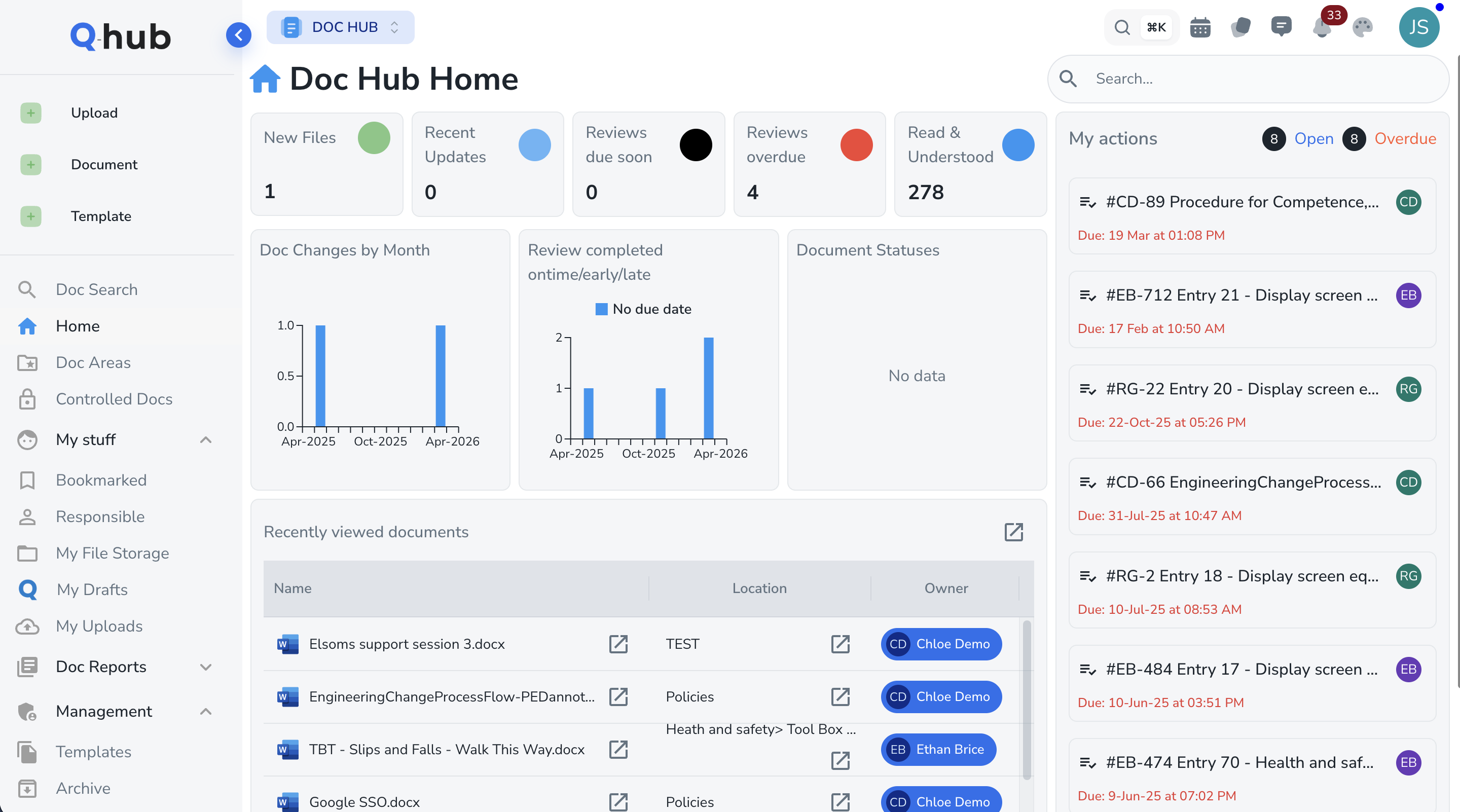
Nonconformance, counterfeit parts and corrective action in one loop
When product does not conform, AS9100 expects fast containment, correct disposition and corrective action driven to genuine root cause. Q-Hub captures nonconformances and part escapes on the shop floor, links them to affected batches and suppliers, and runs the full CAPA loop, while Register Hub keeps counterfeit-part screening and approved-supplier status visible so problem parts are caught before they reach production.
- Raise nonconformance reports on mobile with evidence photos and instant traceability to part and batch
- Structured root-cause analysis and effectiveness checks that satisfy Clause 10 corrective action
- Counterfeit-part screening and certificate-of-conformity records held against approved suppliers
- Live dashboards on open escapes, disposition status and supplier quality performance







AS9100 certification timeline with Q-Hub
Gap analysis & setup
Map your current QMS against AS9100D and ISO 9001. Q-Hub configures Document, Register, Audit and CAPA Hubs around your processes, part numbers and special processes.
Build the evidence
Populate configuration baselines, competency matrices, calibration schedules and supplier registers. Smart Forms start capturing FAI and inspection evidence from day one.
Internal audit & review
Run aerospace internal audits in Audit Hub, close findings through CAPA and hold your management review, so the QMS is proven before the certification body arrives.
Stage 1 & 2 certification
Pass the two-stage certification audit with evidence already retrievable, then maintain conformity through annual surveillance using live dashboards and audit trails.
Ready to simplify AS9100 compliance?
Give your aerospace quality team one system for configuration, first article inspection, counterfeit-parts control and corrective action. See Q-Hub in action.
See PricingNo credit card required · 30-day free trial · Live in 4 weeks
AS9100 FAQs
AS9100D contains the entire text of ISO 9001:2015, so clauses 4 to 10 are identical, and adds roughly 100 aerospace-specific requirements. These cover configuration management, first article inspection, counterfeit-part prevention, product safety, special processes and key characteristics. If you hold AS9100 you effectively meet ISO 9001, but not the other way around. Q-Hub manages both in one QMS.
First article inspection (FAI) is a full documented verification that a manufactured part meets every drawing and specification requirement before series production. AS9100 requires it to follow the AS9102 format, recording each characteristic and result. In Q-Hub, Smart Forms capture FAI against the drawing with measured results and photos, and Document Hub links the report to the released configuration for full traceability.
AS9100D requires organisations to plan and implement processes that prevent the use of counterfeit or suspect unapproved parts, a serious airworthiness risk. That means controlling sources, verifying certificates of conformity and screening incoming material. Q-Hub's Register Hub records approved suppliers, certificates and counterfeit-part checks, while Audit Hub verifies received product, giving assessors clear evidence of your prevention controls.
Special processes such as heat treatment, welding, non-destructive testing and surface finishing cannot be fully verified by inspecting the finished part, so AS9100 requires them to be validated and controlled. Many primes also require NADCAP accreditation for these processes. NADCAP is separate from AS9100 but complementary. Q-Hub's Register Hub flags special processes and Asset Hub controls the equipment and calibration behind them.
For an organisation starting from a reasonably mature quality system, AS9100D certification typically takes six to twelve months, depending on scope, complexity and resource. The path runs through gap analysis, building objective evidence, internal audit, management review and a two-stage certification audit. Q-Hub shortens preparation by configuring your QMS and keeping configuration, FAI and corrective-action evidence audit-ready throughout.
Q-Hub gives aerospace manufacturers one connected QMS. Document Hub controls configuration and released documents, Smart Forms capture FAI and inspection evidence, Register Hub manages risks, approved suppliers and counterfeit-part checks, Asset Hub schedules calibration, Training Hub proves competence, Audit Hub runs internal audits and CAPA drives corrective action. Together they keep AS9100D evidence traceable and instantly retrievable for every audit.
AS9100 Audit-Readiness Checklist
AS9100D · Aerospace quality management
The aerospace additions on top of ISO 9001: configuration management, first article inspection, counterfeit-part prevention and product safety, clause by clause.
A starting point, not certification advice. Q-Hub is not a certification body.