
ISO 14001 compliance software to manage your environmental management system from assessment to certification.
Run your environmental management system in one place, track aspects, legal obligations and objectives, and keep certification evidence ready from first assessment to your ISO 14001 audit.
ISO 14001 compliance, ready to deploy
Bring your environmental aspects, legal register, objectives and audits together in one system your team actually uses, and keep your ISO 14001 evidence certification-ready.
See PricingNo credit card required · 30-day free trial · Live in 4 weeks
What is ISO 14001?
ISO 14001 is the international standard for environmental management systems (EMS). It gives organisations a framework to identify their environmental aspects and impacts, meet compliance obligations, set measurable objectives, and continually improve environmental performance. Any organisation can adopt it, regardless of size or sector, and it is widely used by UK and EU manufacturers to reduce environmental risk, cut waste and energy use, and demonstrate credible environmental responsibility to customers, regulators and supply chains.
Certification is awarded by an accredited body after a two-stage audit: a Stage 1 review of your EMS documentation and readiness, followed by a Stage 2 assessment of how the system works in practice. Once certified, surveillance audits typically follow each year, with full recertification every three years. Auditors look for evidence that your aspects register, legal compliance obligations, operational controls, emergency preparedness and corrective actions are live and maintained, not just written down once and forgotten.
How Q-Hub maps to ISO 14001 clauses
Clauses 1 to 3 of the standard cover scope, normative references, and terms and definitions. The auditable requirements begin at clause 4, which is where this table starts.
| Clause | Requirement | How Q-Hub helps |
|---|---|---|
| Clause 4, Context of the organisation | Understand internal and external issues, interested parties and their needs, and define the scope of your EMS. | Register Hub captures interested parties and their environmental expectations; EMS scope and boundaries documented and controlled in Document Hub. |
| Clause 5, Leadership | Demonstrate top-management commitment, establish an environmental policy, and assign roles and responsibilities. | Environmental policy version-controlled and distributed in Document Hub; responsibilities tracked with acknowledgements and competency records in Training Hub. |
| Clause 6, Planning | Identify significant environmental aspects and impacts, determine compliance obligations, and set objectives to address risks. | Register Hub holds the aspects register and legal/compliance obligations register; environmental objectives and targets tracked to owners with live Company KPIs. |
| Clause 7, Support | Provide resources, ensure competence and awareness, manage communication, and control documented information. | Training Hub manages competency matrices and awareness records; Document Hub controls procedures, versions and approvals across the EMS. |
| Clause 8, Operation | Plan and control operations that affect the environment, and establish emergency preparedness and response. | Smart Forms digitise operational controls and checks with mobile evidence capture; emergency preparedness plans and drill records maintained in Register Hub and Document Hub. |
| Clause 9, Performance evaluation | Monitor and measure performance, evaluate compliance, run internal audits and hold management reviews. | Company KPIs track environmental performance in real time; Audit Hub schedules internal audits and evaluation of compliance, feeding management review with live data. |
| Clause 10, Improvement | Address nonconformities with corrective action and continually improve the EMS. | CAPA logs nonconformities, drives root cause analysis and corrective actions with effectiveness checks, evidencing continual improvement of your EMS. |
Competitor pricing as published by each vendor. Figures marked ≈ are converted from the currency they were published in at today’s rate, for comparison only.
Be ready for certification audits and environmental assessments
ISO 14001 audits test whether your EMS is genuinely live, aspects assessed, legal obligations current, objectives progressing and corrective actions closed. Q-Hub keeps every record timestamped, owned and instantly retrievable, so you walk into surveillance audits with evidence already in order.
Aspects and impacts on demand
Your environmental aspects register, significance ratings and controls stay current in Register Hub, so auditors see live assessments rather than a stale annual spreadsheet.
Legal compliance evidence
Every compliance obligation is linked to its evidence and evaluation date, so you can prove ongoing conformance with environmental legislation in seconds during a Stage 2 audit.
Objectives you can show progress on
Environmental objectives and targets track against live KPIs, giving auditors clear evidence of measurable improvement rather than good intentions on paper.
Corrective actions closed out
CAPA records show each nonconformity, its root cause, actions taken and effectiveness check, demonstrating the continual improvement loop auditors expect to see working.
Identify and control your significant environmental aspects
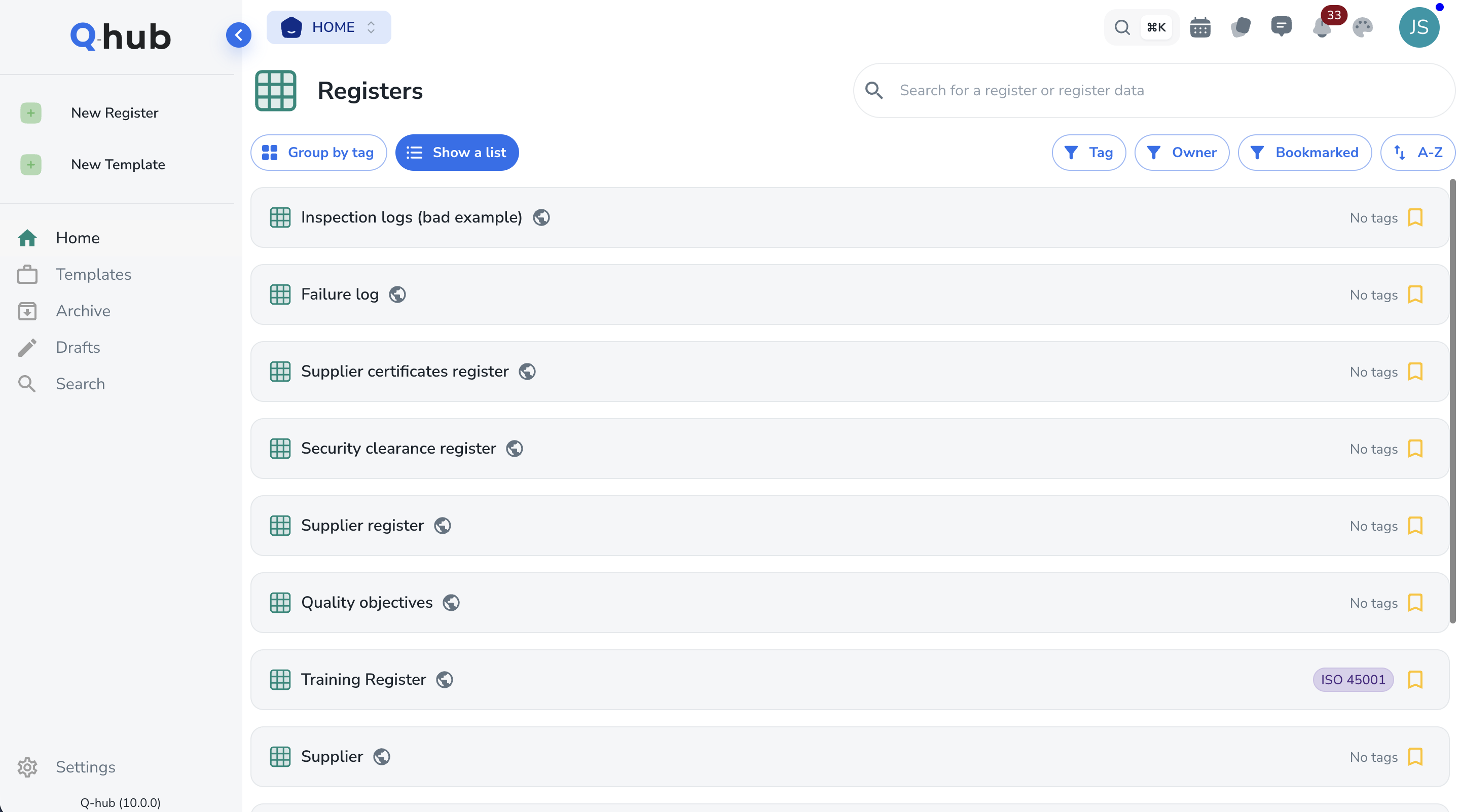
Identifying your significant environmental aspects is the foundation of ISO 14001. Register Hub gives you a configurable aspects register to record activities, their environmental impacts, and a consistent significance rating, covering emissions, waste, energy, water and materials. Link each significant aspect to its operational controls and objectives, keep assessments under review, and give auditors a clear, defensible line from activity to control.
- Configurable aspects and impacts register with consistent significance scoring
- Cover emissions, waste, water, energy, resource use and land contamination
- Link significant aspects to operational controls, objectives and owners
- Keep assessments under periodic review with a full change history
Stay on top of environmental legislation and compliance obligations
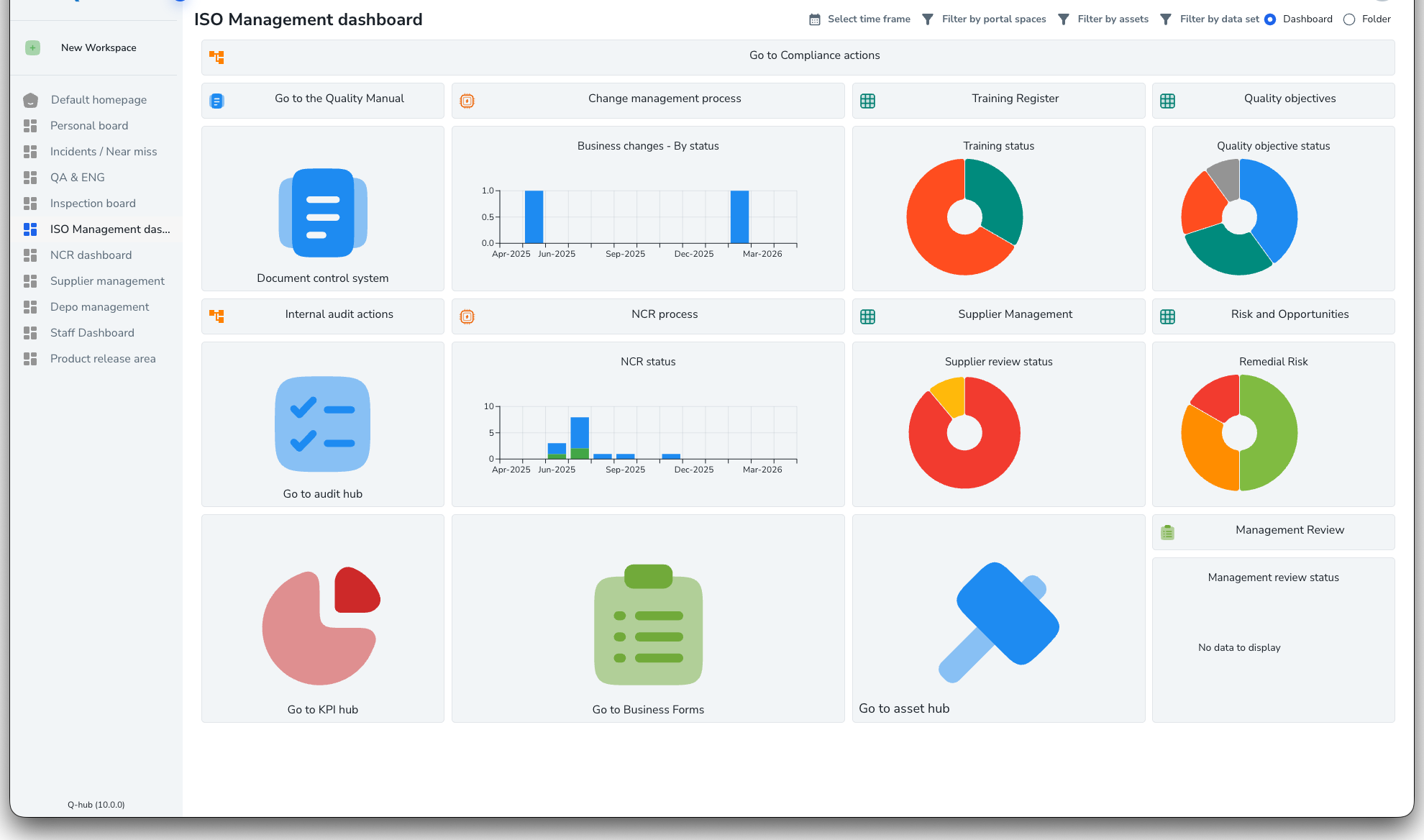
Environmental legislation moves quickly, and ISO 14001 expects you to keep pace. Register Hub maintains a live register of your compliance obligations, permits, consents, regulations and other requirements, each with an owner, evaluation date and linked evidence. Smart Forms capture the checks that prove ongoing compliance, and the management dashboard flags what is due, so nothing slips before your next evaluation or surveillance audit.
- Central register of legal and other environmental compliance obligations
- Track permits, consents and regulatory requirements with owners and review dates
- Evaluate compliance with linked evidence and Smart Forms checks
- Dashboard alerts flag upcoming reviews so obligations never lapse




ISO 14001 certification timeline with Q-Hub
Gap analysis and setup
Assess your current EMS against ISO 14001, configure Register Hub, Document Hub and Audit Hub, and load your aspects and compliance obligations to close identified gaps.
Build and embed the EMS
Publish your environmental policy, operational controls and emergency plans in Document Hub, set objectives against KPIs, and train staff with Training Hub competency records.
Internal audit and review
Run internal audits in Audit Hub, evaluate compliance, resolve findings through CAPA, and hold your management review, building the evidence trail for certification.
Certification and surveillance
Pass Stage 1 and Stage 2 with evidence ready to hand, then keep the EMS live for annual surveillance and three-yearly recertification with minimal extra effort.
Ready to simplify ISO 14001 compliance?
See how Q-Hub keeps your environmental aspects, legal obligations, objectives and audits in one connected system, and makes ISO 14001 certification far less painful.
See PricingNo credit card required · 30-day free trial · Live in 4 weeks
How ready are you for ISO 14001?
Answer six quick questions to see where you stand and where Q-Hub can close the gaps.
- Have you identified your significant environmental aspects and impacts?
- Do you maintain a legal and compliance-obligations register that stays current?
- Are environmental objectives set with plans and progress tracked?
- Are operational controls and emergency preparedness documented?
- Do you evaluate compliance and run internal environmental audits?
- Are nonconformances and corrective actions managed to closure?
ISO 14001 FAQs
ISO 14001 is the international standard for environmental management systems. It provides a framework to identify environmental aspects and impacts, meet compliance obligations, set objectives and continually improve environmental performance. It applies to any organisation and is widely used by UK and EU manufacturers to reduce environmental risk and demonstrate responsibility.
Any organisation wanting to manage its environmental impact can certify, but it is especially common for manufacturers and industrial businesses. Many customers, tenders and supply chains now require it. Certification signals credible environmental management to regulators and clients, and often supports permit conditions and corporate sustainability commitments.
An environmental aspect is an element of your activities that interacts with the environment, such as emissions, waste, water or energy use. The impact is the resulting change, like pollution or resource depletion. ISO 14001 requires you to identify these, judge their significance, and control the significant ones. Q-Hub's Register Hub manages this register.
For many organisations it takes around three to six months, depending on size and how mature your existing practices are. The main effort is building and embedding the EMS, running internal audits and a management review before the Stage 1 and Stage 2 audits. Q-Hub shortens setup by structuring aspects, obligations and audits from day one.
Q-Hub brings your whole EMS together: Register Hub for environmental aspects and compliance obligations, Document Hub for policy and procedures, Audit Hub for internal audits and compliance evaluation, and CAPA for corrective actions. Company KPIs track objectives in real time, so evidence stays live and certification-ready between surveillance audits.
ISO 9001 is the quality management standard, focused on consistently meeting customer requirements. ISO 14001 is the environmental management standard, focused on managing environmental aspects and impacts. Both share the same Annex SL structure, so they integrate well. Q-Hub supports both from one platform, letting you run a combined management system without duplication.
Explore Q-Hub for ISO 14001
The tools behind ISO 14001 compliance, plus related standards Q-Hub supports.