
ISO/IEC 17025 accreditation made simpler: control methods, equipment and results in one place
Q-Hub gives testing and calibration laboratories a single system for equipment calibration, metrological traceability, method control, competence records and accreditation-ready evidence.
Get ISO 17025 accreditation-ready faster
See how testing and calibration labs use Q-Hub to keep equipment traceable, methods validated and results verified before the UKAS assessor arrives.
See PricingNo credit card required · 30-day free trial · Live in 4 weeks
What is ISO/IEC 17025?
ISO/IEC 17025:2017 is the international standard for the competence of testing and calibration laboratories. It sets out the general requirements a laboratory must meet to demonstrate that it operates competently, produces valid results and is technically capable of the activities in its scope. Published jointly by ISO and IEC, it applies to any laboratory performing testing, calibration or sampling, whether it is an independent commercial lab, an in-house quality laboratory or part of a larger organisation, regardless of the number of staff.
Unlike ISO 9001, a laboratory is accredited to ISO 17025, not certified. In the UK, accreditation is granted by UKAS, the national accreditation body, against a defined scope of methods. Assessment involves document review followed by an on-site assessment of technical competence and the management system, then ongoing surveillance visits and periodic reassessment. Assessors expect objective evidence for equipment calibration, metrological traceability, method validation, measurement uncertainty, staff competence and ensuring the validity of results, so keeping that evidence current and retrievable is essential.
How Q-Hub maps to ISO/IEC 17025 clauses
Clauses 1 to 3 of the standard cover scope, normative references, and terms and definitions. The auditable requirements begin at clause 4, which is where this table starts.
| Clause | Requirement | How Q-Hub helps |
|---|---|---|
| Clause 4, General requirements: impartiality & confidentiality | Safeguard laboratory impartiality, identify and manage risks to objectivity, and protect the confidentiality of customer information and results generated by the laboratory. | Register Hub tracks impartiality risks and conflicts of interest with assigned owners; Document Hub controls confidentiality agreements, the impartiality policy and staff read-and-understood sign-off. |
| Clause 5, Structural requirements | Define the laboratory's legal identity, management responsibilities, organisational structure and scope of laboratory activities, with staff who have authority and resource to carry out their duties. | Document Hub holds the organisation chart, scope of accreditation, role descriptions and delegated authorities as version-controlled documents visible to every member of staff. |
| Clause 6, Resource requirements: personnel, facilities & equipment | Ensure competent personnel, suitable facilities and controlled environmental conditions, and equipment that is fit for purpose, maintained and calibrated to deliver valid results. | Training Hub maintains competency matrices with authorisation and certification-expiry alerts; Smart Forms log environmental monitoring; Asset Hub manages the equipment register with calibration and maintenance schedules. |
| Clause 6.5, Metrological traceability | Establish and maintain metrological traceability of measurement results to the SI through an unbroken chain of calibrations, each contributing to measurement uncertainty. | Asset Hub records each item's calibration certificates, traceability chain and due dates, storing accredited-lab certificates against equipment and alerting before calibration lapses. |
| Clause 7, Process requirements: method selection, validation & sampling | Review requests and contracts, select and validate appropriate methods, control sampling, and handle test and calibration items so results remain valid and defensible. | Document Hub controls methods, procedures and validation records with approval workflows; Smart Forms capture sampling, item receipt and handling with evidence photos and full traceability. |
| Clause 7.6 & 7.7, Measurement uncertainty & ensuring validity of results | Evaluate measurement uncertainty for calibrations and tests, and monitor the validity of results through quality control, replicate testing and proficiency testing or interlaboratory comparisons. | Document Hub holds uncertainty budgets and QC procedures; Smart Forms and Company KPIs track quality-control checks and proficiency-testing outcomes, with CAPA triggered when results fall outside acceptance criteria. |
| Clause 8, Management system: documents, records, corrective action & internal audit | Operate a management system covering control of documents and records, actions to address risk, internal audits, management review and corrective action for nonconforming work. | Document Hub controls documents and technical records with retention rules; Audit Hub schedules internal audits with findings; CAPA drives corrective action to root cause and effectiveness check. |
Competitor pricing as published by each vendor. Figures marked ≈ are converted from the currency they were published in at today’s rate, for comparison only.
Walk into your UKAS assessment with evidence already in order
ISO 17025 assessors demand traceable, objective evidence for calibration, method validation, measurement uncertainty and staff competence. Q-Hub keeps every record time-stamped, linked and instantly retrievable, so surveillance visits and reassessments stop being a scramble.
Calibration always current
Asset Hub schedules every calibration and maintenance task with due-date alerts, so no instrument drifts out of tolerance and no certificate expires unnoticed before an assessment.
Traceability on demand
Each result links back through an unbroken chain of calibration certificates to the SI, so metrological traceability evidence is one click away for the assessor.
Methods validated & versioned
Document Hub holds every method, validation record and uncertainty budget under version control, so the current, approved procedure is always the one in use on the bench.
Competence proven
Training Hub records authorisation, training and certification expiry for every analyst, so you can show exactly who is competent to run each method under your scope.
Equipment calibration and metrological traceability under control
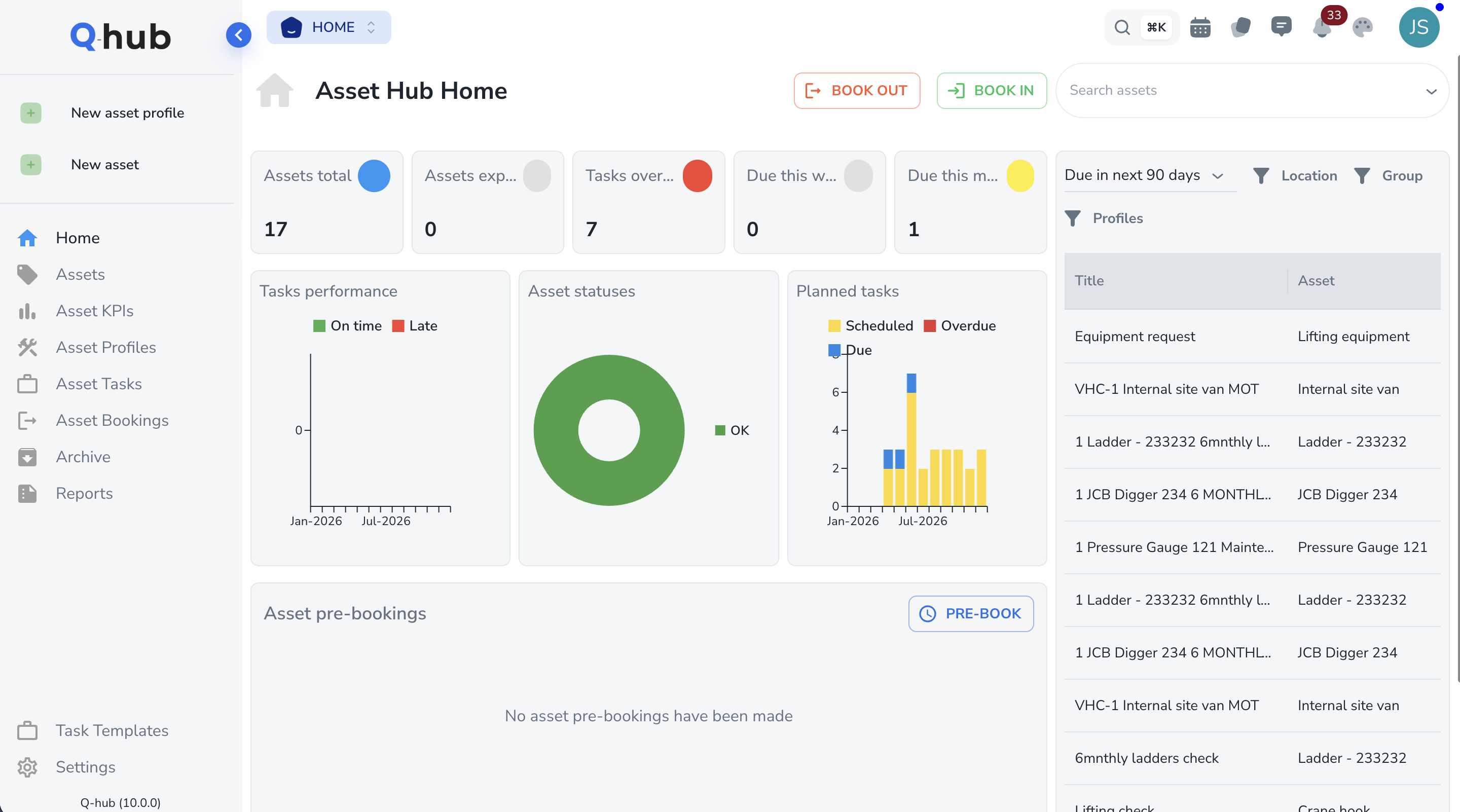
ISO 17025 accreditation depends on knowing that every instrument is fit for purpose, calibrated and traceable to the SI. Asset Hub gives you a live equipment register where each item carries its calibration schedule, maintenance history, accredited-lab certificates and full traceability chain. Automatic due-date alerts mean nothing slips out of calibration, and when an item is found out of tolerance you can immediately see which results may be affected.
- Complete equipment register with calibration and maintenance schedules and automatic due-date alerts
- Calibration certificates stored against each asset with the traceability chain back to the SI
- Out-of-tolerance handling that flags affected results and links straight into corrective action
- Instant retrieval of any instrument's status and history for UKAS surveillance and reassessment
Method control, competence records and control of data in one place
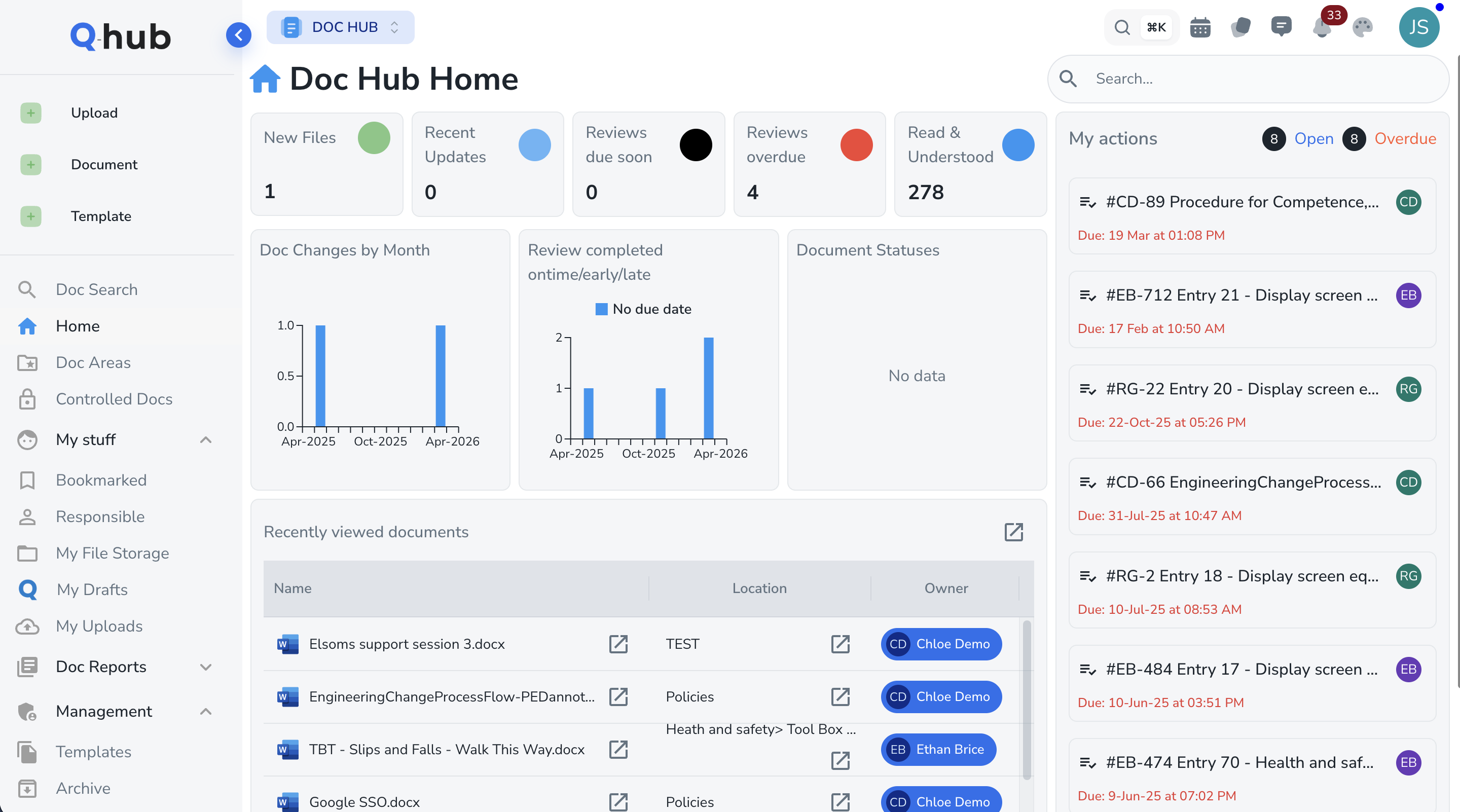
ISO 17025 expects the current, validated method to be in use, run by competent staff, with technical records and data protected against loss or unauthorised change. Document Hub controls every method, procedure, validation record and technical record under enforced approval workflows and version history, while Training Hub proves who is authorised to perform each activity. Together they keep obsolete methods off the bench and give assessors a clean, traceable line from method to result.
- Version-controlled methods, procedures and validation records with enforced approval workflows
- Competency matrices in Training Hub linking each analyst to the methods they are authorised to run
- Technical records and data captured with time stamps, retention rules and controlled access
- Controlled distribution with read-and-understood sign-off so only the current method is ever used








ISO 17025 accreditation timeline with Q-Hub
Gap analysis & setup
Map your current laboratory practice against ISO 17025. Q-Hub configures Asset, Document, Training, Audit and CAPA Hubs around your methods, equipment and scope of accreditation.
Build the evidence
Populate the equipment register, calibration schedules, method and validation records and competency matrices. Smart Forms start capturing sampling, QC checks and environmental monitoring from day one.
Internal audit & review
Run internal audits in Audit Hub, verify measurement uncertainty and validity of results, close findings through CAPA and hold your management review before UKAS assesses you.
UKAS assessment & surveillance
Pass document review and on-site assessment with evidence already retrievable, then maintain accreditation through surveillance visits and reassessment using live dashboards and audit trails.
Ready to simplify ISO 17025 compliance?
Give your laboratory one system for calibration, traceability, method control, competence and corrective action. See Q-Hub in action.
See PricingNo credit card required · 30-day free trial · Live in 4 weeks
ISO 17025 FAQs
ISO 9001 certifies that an organisation runs an effective quality management system. ISO/IEC 17025 goes further for laboratories, adding requirements for technical competence so that results are demonstrably valid and traceable. Crucially, a laboratory is accredited to 17025, not certified, and in the UK accreditation is granted by UKAS against a specific scope of methods. Q-Hub manages the management-system and technical evidence for both in one place.
Measurement uncertainty is a quantified estimate of the doubt around a result, expressing the range within which the true value is expected to lie. Clause 7.6 requires laboratories to identify the contributions to uncertainty and evaluate it for calibrations and, where relevant, tests. Q-Hub's Document Hub holds your uncertainty budgets and procedures under version control, linking them to the methods and equipment that feed each calculation.
Under clause 7.2, laboratories must use appropriate methods and confirm they can perform them correctly before use. Standard methods need verification; non-standard or modified methods need full validation covering parameters such as accuracy, precision, range, limit of detection and robustness. Q-Hub's Document Hub controls each method and its validation record with approval workflows and version history, so the validated, current procedure is always the one in use.
Clause 7.7 requires laboratories to monitor the validity of their results, and proficiency testing or interlaboratory comparison is a key way to do this: your lab tests the same sample as others and compares outcomes against an assigned value. Poor performance signals a problem to investigate. In Q-Hub, Company KPIs and Smart Forms track proficiency-testing and quality-control results, and CAPA is triggered automatically when outcomes fall outside acceptance criteria.
For a laboratory with reasonably mature practice, ISO 17025 accreditation typically takes nine to eighteen months, depending on the size of the scope, the number of methods and available resource. The path runs through gap analysis, building technical and management-system evidence, internal audit, management review and the UKAS assessment. Q-Hub shortens preparation by configuring your system and keeping calibration, method and validity evidence assessment-ready throughout.
Q-Hub gives laboratories one connected system. Asset Hub manages the equipment register, calibration and metrological traceability, Document Hub controls methods, validation records and technical records, Training Hub proves competence, Smart Forms capture sampling and quality control, Audit Hub runs internal audits and CAPA drives corrective action. Together they keep ISO 17025 evidence traceable and instantly retrievable for every UKAS surveillance visit and reassessment.
ISO/IEC 17025 Audit-Readiness Checklist
ISO/IEC 17025:2017 · Testing and calibration laboratories
Impartiality, competence, equipment and metrological traceability, method validation and measurement uncertainty, clause by clause for a laboratory seeking accreditation.
A starting point, not certification advice. Q-Hub is not a certification body.