
HACCP made digital, from hazard analysis to live critical control point monitoring
Manage your HACCP plan in Q-Hub. Hold your hazard analysis and CCP register, capture CCP monitoring records on mobile and log corrective actions, so your food safety evidence stays complete and audit-ready.
Turn HACCP from paperwork into a living system
Keep your hazard analysis, CCP monitoring and corrective actions live every day, so food safety is controlled in real time rather than reconstructed at audit.
See PricingNo credit card required · 30-day free trial · Live in 4 weeks
What is HACCP?
HACCP (Hazard Analysis and Critical Control Points) is the internationally recognised, systematic method for managing food safety. Defined in the Codex Alimentarius, it identifies biological, chemical and physical hazards and controls them at the points that matter most rather than relying on end-product testing. It applies across food and beverage manufacturing, processing, packing, catering and distribution, and it is the food safety foundation that underpins GFSI schemes such as BRCGS, FSSC 22000 and SQF. In the UK and EU it is a legal expectation for food businesses.
A HACCP study follows preliminary steps then applies seven principles: hazard analysis, determining critical control points, setting critical limits, monitoring each CCP, defining corrective actions, verifying the system works and keeping documentation and records. HACCP is a methodology rather than a certificate, but the plan and its records are assessed by enforcement officers and by third-party auditors during GFSI or customer audits. Keeping monitoring records, verification and documentation current is what proves the system is genuinely in control.
How Q-Hub maps to the 7 HACCP principles
| HACCP Principle | What it requires | How Q-Hub helps |
|---|---|---|
| 1. Conduct a hazard analysis | Identify the biological, chemical and physical hazards at each process step, assess their likelihood and severity, and define control measures. | Register Hub holds the hazard analysis as a configurable register, capturing each hazard, its risk rating and the control measure against every process step for a single, controlled source of truth. |
| 2. Determine the Critical Control Points (CCPs) | Use a decision approach to establish the steps where control is essential to prevent, eliminate or reduce a significant hazard to an acceptable level. | Register Hub records each CCP with its rationale and links it to the hazard it controls, so your CCP register is documented, justified and easy to review or revise. |
| 3. Establish critical limits for each CCP | Set measurable, validated limits such as temperature, time, pH or metal-detector sensitivity that separate safe from unsafe product at each CCP. | Critical limits are held against each CCP in Register Hub and shown on the Smart Forms your team uses to record monitoring checks, so the validated limit is visible to the operator at the point of capture. |
| 4. Establish monitoring procedures for each CCP | Define what is measured, how, how often and by whom, with monitoring frequent enough to detect loss of control at each CCP. | Smart Forms capture CCP monitoring records on mobile with photo evidence, timestamps and the operator recorded, while Asset Hub keeps monitoring equipment such as probes and detectors calibrated. |
| 5. Establish corrective actions | Predefine the actions to take when monitoring shows a critical limit has been breached, including control of affected product and restoring control. | When a monitoring record shows a critical limit has been breached, raise a CAPA with root cause, owner and deadline, so product is segregated, the deviation is corrected and effectiveness is verified and evidenced. |
| 6. Establish verification procedures | Confirm the HACCP plan is working through activities such as record review, calibration checks, internal audits and periodic revalidation. | Audit Hub runs verification and internal audit checklists on a schedule, and dashboards surface monitoring record completion and overdue checks, so verification is evidenced rather than assumed. |
| 7. Establish documentation and record-keeping | Maintain the HACCP plan, supporting procedures and monitoring records, with traceability that proves control across each batch. | Document Hub version-controls the HACCP plan and procedures with approval trails, Smart Forms retain completed monitoring records, and Register Hub supports fast forward and backward traceability. |
Competitor pricing as published by each vendor. Figures marked ≈ are converted from the currency they were published in at today’s rate, for comparison only.
HACCP evidence that is complete and current every day
HACCP audits and inspections dig into whether monitoring actually happened, whether limits held and whether deviations were controlled. Q-Hub keeps CCP monitoring, verification and corrective actions live, so the evidence is one search away rather than a scramble.
CCP monitoring records
Critical control point checks captured on mobile with photo evidence and timestamps, so monitoring records are complete, legible and always ready to review.
Critical limits at capture
Validated critical limits are shown on the Smart Form as readings are recorded, so the operator can see when a result falls outside the limit and raise corrective action.
Verified and traceable
Verification checks, calibration and record review are scheduled and logged, with batch traceability that proves control from raw material to finished product.
Corrective actions closed
When a record shows a deviation, a CAPA is raised with root cause, owner and deadline, so affected product is controlled and the action is closed out and verified on record.
Build and manage your HACCP plan with digital records
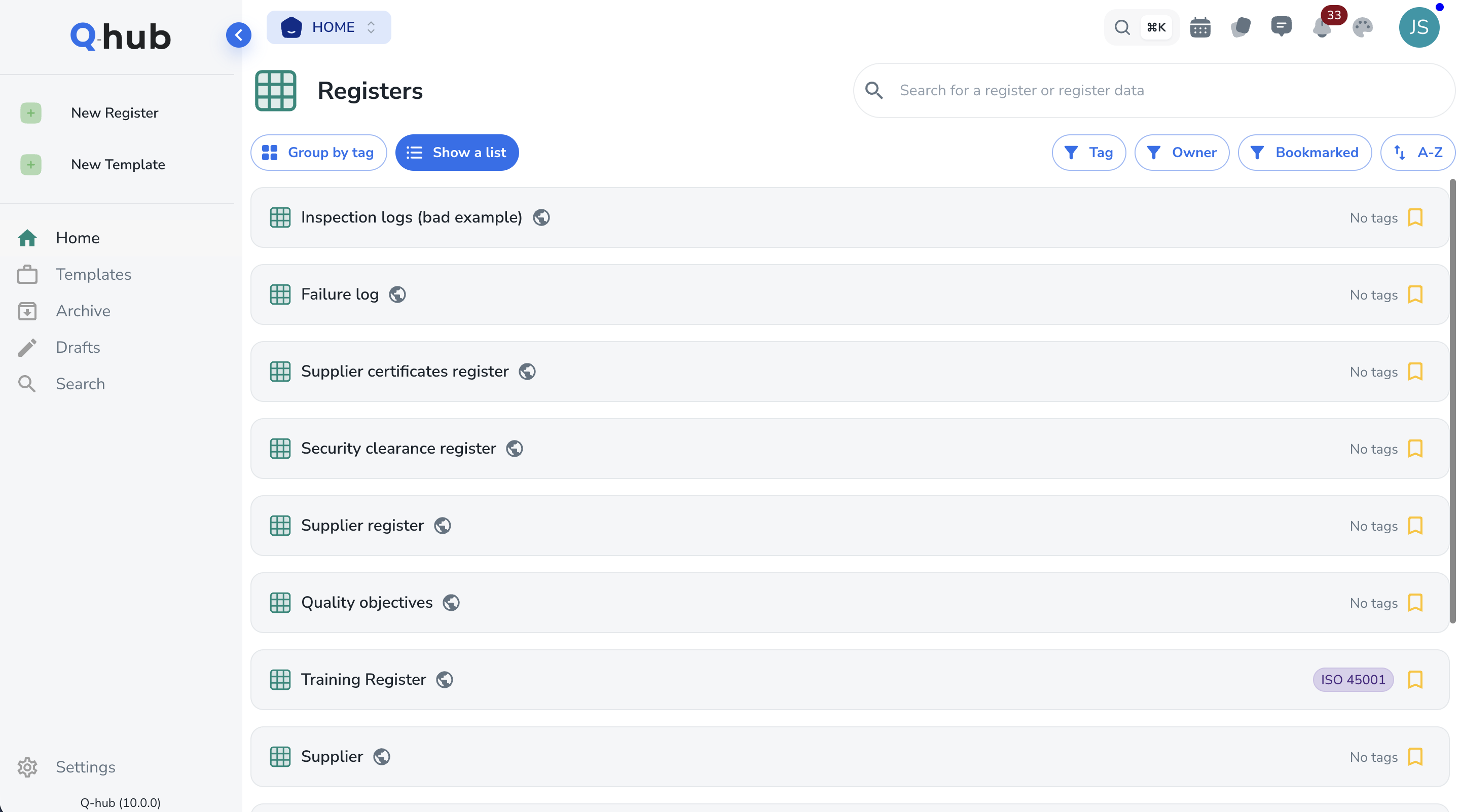
Hold your whole HACCP study in Q-Hub and connect it to daily record-keeping. Register Hub captures the hazard analysis, critical control points and validated critical limits as configurable registers, while Smart Forms turn CCP monitoring into mobile checks with photo evidence. Each form shows the validated limit at the point of capture, so operators record readings against the limit and raise corrective action when a result falls outside it.
- Hazard analysis, CCPs and critical limits held in one controlled register
- CCP monitoring captured on mobile with photo evidence and timestamps
- Validated critical limits shown at the point of capture for every monitoring check
- Dashboards show CCP monitoring record completion across every line and shift
Records, traceability and corrective action
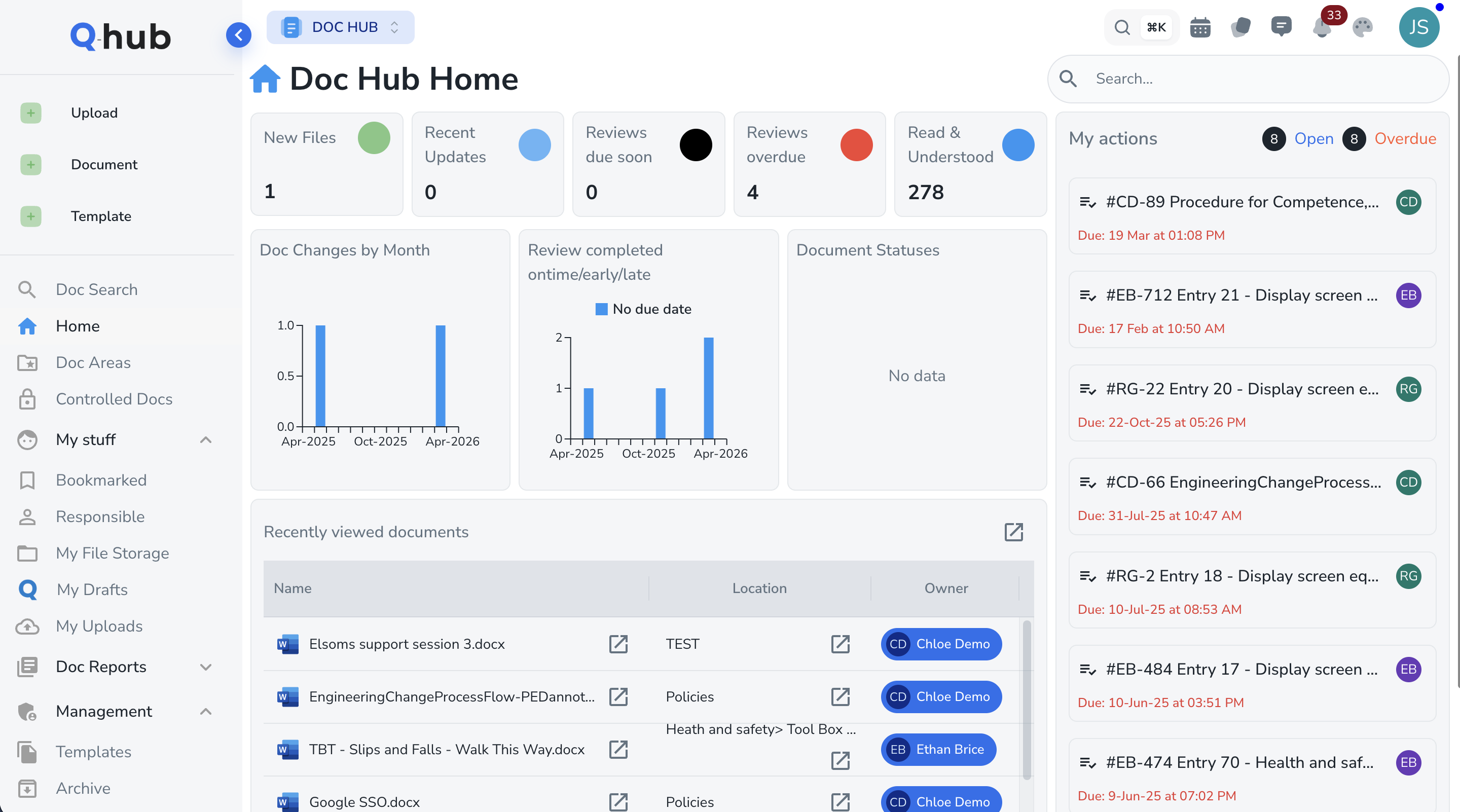
HACCP is only credible if you can prove control. Document Hub version-controls the HACCP plan, procedures and prerequisite programmes with full approval trails and controlled distribution, so everyone works to the current study. Completed monitoring records are retained against each CCP, batch traceability sits in Register Hub, and when a record shows a critical limit has been breached you can raise a CAPA with root cause analysis and effectiveness checks, so corrective actions are closed out and evidenced.
- Version control and approval workflows for the HACCP plan and procedures
- Completed CCP monitoring records retained and searchable by batch or date
- Forward and backward traceability for rapid mass-balance and recall exercises
- CAPA with root cause and effectiveness checks to close every deviation









HACCP implementation timeline with Q-Hub
Scope & hazard analysis
Define the product, process and prerequisite programmes, then build the hazard analysis in Register Hub, rating each hazard against every process step.
Set CCPs & critical limits
Determine critical control points, record validated critical limits against each one and configure the Smart Forms that will monitor them on the floor.
Monitor & verify
Run digital CCP records, schedule verification and calibration in Audit Hub and Asset Hub, and route any breach to corrective action through CAPA.
Maintain & improve
Keep records live, review and revalidate the plan as products or processes change, and stay ready for enforcement inspections and GFSI or customer audits.
Ready to simplify HACCP compliance?
See how Q-Hub keeps your HACCP plan, CCP monitoring and corrective actions live every day, so food safety stays in control and the evidence is always ready.
See PricingNo credit card required · 30-day free trial · Live in 4 weeks
HACCP FAQs
HACCP (Hazard Analysis and Critical Control Points) is the Codex Alimentarius method for managing food safety by controlling hazards at the points that matter. After preliminary steps, it applies seven principles: conduct a hazard analysis, determine the critical control points, establish critical limits, establish monitoring procedures, establish corrective actions, establish verification procedures, and establish documentation and record-keeping. Q-Hub supports all seven with Register Hub, Smart Forms, CAPA, Audit Hub and Document Hub.
A critical control point is a step in the process where control is essential to prevent, eliminate or reduce a significant food safety hazard to an acceptable level, such as a cook step, a chill step or metal detection. Each CCP needs a validated critical limit, monitoring and corrective action. In Q-Hub, CCPs are held in Register Hub with their limits, and Smart Forms capture the monitoring records, showing the validated limit at the point of capture so operators can raise corrective action when a reading falls outside it.
HACCP is a food safety methodology, not a certificate. BRCGS, FSSC 22000 and ISO 22000 are certification schemes that require a robust, Codex-based HACCP plan and add wider management-system requirements around it. In other words, HACCP is the food safety core those schemes are built on. Q-Hub supports HACCP as the foundation and extends into the documents, audits, training and traceability those GFSI standards also expect.
Yes. Under EU Regulation 852/2004, retained in Great Britain, food business operators must put in place, implement and maintain procedures based on HACCP principles, proportionate to the business. Environmental health and food safety officers assess these procedures during inspections. Smaller businesses may use HACCP-based tools such as Safer Food Better Business. Q-Hub gives food manufacturers a structured way to build, record and evidence those HACCP-based procedures.
There is no single HACCP certificate for a site in the way there is for BRCGS or ISO 22000; instead, the plan is verified through internal verification, enforcement inspection and third-party GFSI or customer audits, while individuals can hold HACCP training certificates. Verification confirms the plan works through record review, calibration and audits. Q-Hub schedules and logs verification in Audit Hub and keeps the records that prove the system is in control.
Q-Hub supports all seven HACCP principles in one platform. Register Hub holds the hazard analysis, CCPs and critical limits, Smart Forms capture CCP monitoring records on mobile with photo evidence, and Asset Hub keeps monitoring equipment calibrated. When a record shows a reading outside its critical limit you can raise a CAPA, Audit Hub runs verification, Training Hub manages competency, and Document Hub version-controls the plan and records, keeping your HACCP records complete and audit-ready every day.