ISO 14001 environmental management — from aspects register to certification
Map every clause of ISO 14001:2015 to your environmental management system. Aspects and impacts register, legal compliance tracking, waste management, emissions monitoring, and environmental audits — all in one platform.







Operational controls that reduce your environmental footprint
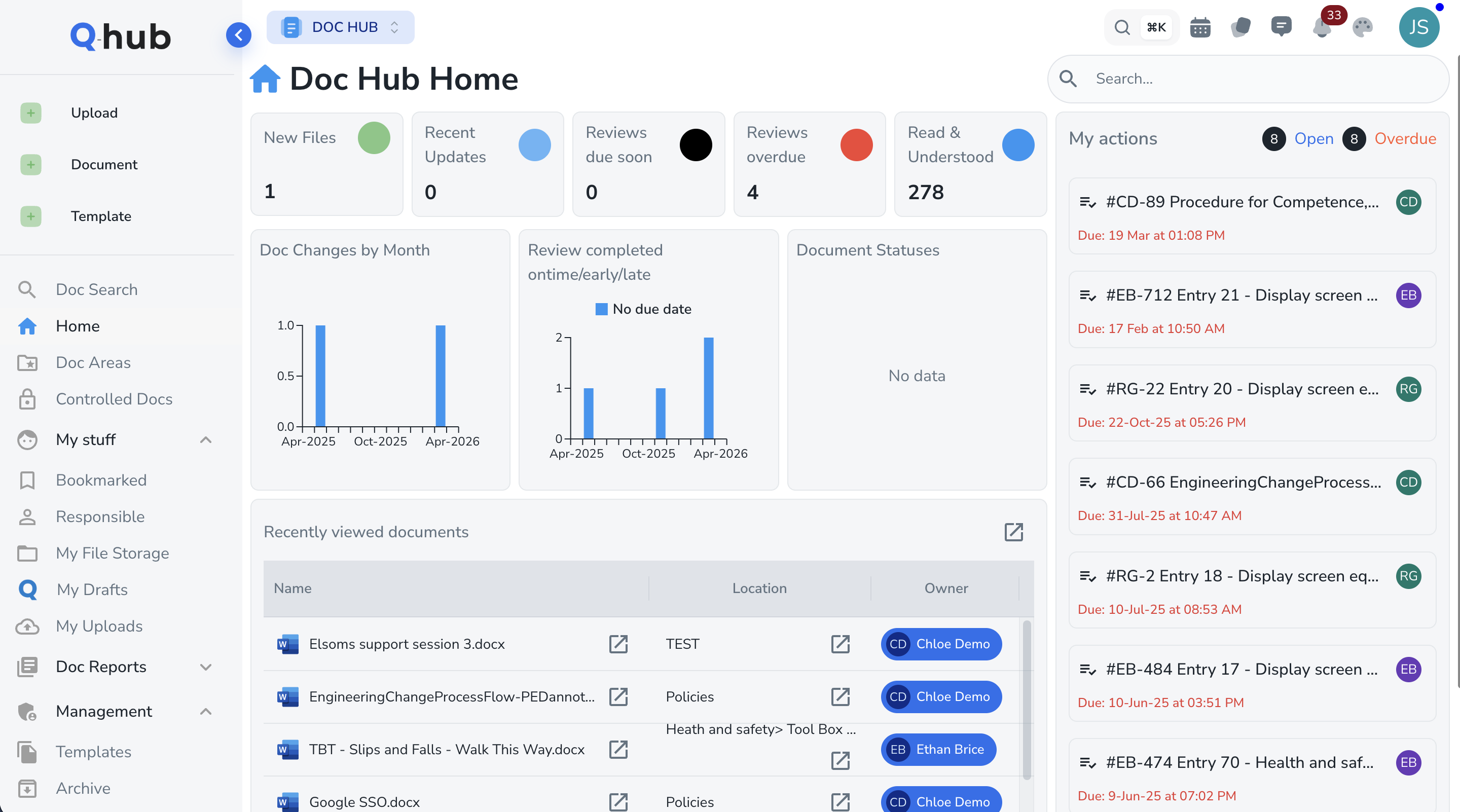
ISO 14001 requires you to plan and control operations associated with significant environmental aspects. Q-Hub provides waste management tracking with duty of care records, emissions monitoring with automated threshold alerts, water and energy consumption logging, and spill response plan management — all linked to your aspects register so controls are proportionate to environmental significance.
- Waste management tracking with consignment notes and duty of care
- Emissions monitoring with automated exceedance alerts
- Energy and water consumption tracking against targets
- Emergency preparedness and spill response plan management
How Q-Hub maps to ISO 14001 requirements
| Feature | Clause | Requirement | Q-Hub Coverage | Q-Hub |
|---|---|---|---|---|
| 4. Environmental Context | Understand internal/external environmental issues and interested parties | Stakeholder register, context analysis templates, scope documentation | ✓ | |
| 5. Environmental Policy | Environmental policy, leadership commitment, roles and responsibilities | Document Hub with controlled policy distribution, role-based access | ✓ | |
| 6. Aspects & Compliance | Environmental aspects, compliance obligations, objectives and targets | Environmental aspects register, legal register, objectives tracking with KPIs | ✓ | |
| 7. Competence & Communication | Competence, awareness, communication, documented information | Training matrices, environmental awareness records, Document Control | ✓ | |
| 8. Operational Planning | Operational planning and control, emergency preparedness | Waste management tracking, emissions monitoring, spill response plans | ✓ | |
| 9. Evaluation & Audit | Monitoring, compliance evaluation, internal audit, management review | Environmental audit scheduling, compliance evaluation workflows, KPI dashboards | ✓ | |
| 10. Improvement | Nonconformity, corrective action, continual improvement | Environmental NCR tracking, CAPA management, trend analysis | ✓ |
Trusted by compliance teams worldwide
“Qhub provides a visible, intuitive way to manage data and workflows, revolutionising our approach to operations”
Fowlers of Bristol (Engineers) Ltd
Operations director
“Qhub helps us to... proactively use our QMS... and increase efficiency”
Anglia Cathodic Protection Services
Business manager
“Really made a difference with providing compliance during audits – both regulatory, customer, and internal.”

Auxitrol Weston
Quality manager
“QHub has supported us in achieving a higher compliance rate.”
BMC Analysis
Technical Manager/ Quality Manage
“We can't believe how fast we were able to get it up and running.”

Cawood Group
“Managing NCRs are now so much easier”

Enviromesh
Quality manager
“Where was this 2 years ago... we're blown away”

Jaltek
Compliance manager for Jaltek
“Qhub has improved our safety management system no end, making it very efficient”

Rocal Endurance Doors
Compliance manager
“We use it for as much as possible.”

Scottish Leather Group
Compliance manager
ISO 14001 FAQs
An environmental aspects register is a core requirement of ISO 14001 Clause 6.1.2. It identifies all the ways your organisation interacts with the environment (aspects) and the resulting changes to the environment (impacts). For example, an aspect might be "solvent use in painting" and the impact would be "air emissions of VOCs." Q-Hub provides structured templates to score significance based on factors like frequency, severity, legal requirements, and stakeholder concern, then links each significant aspect to its operational controls.
ISO 14001 Clause 6.1.3 requires organisations to determine and have access to their compliance obligations. Q-Hub maintains a live legal register that maps each piece of environmental legislation, permit condition, and consent requirement to your specific activities. The platform schedules periodic compliance evaluations, tracks permit condition deadlines, and generates compliance status reports that demonstrate ongoing legal compliance to auditors and regulators.
ISO 14001 Clause 9.1 requires monitoring, measurement, analysis, and evaluation of environmental performance. Common KPIs include energy consumption per unit of output, water usage, waste volumes and recycling rates, carbon emissions, hazardous waste quantities, number of environmental incidents, and compliance evaluation results. Q-Hub provides configurable dashboards to track all of these with automated data collection where possible, trend charts to demonstrate continual improvement, and threshold alerts when values approach permit limits.
Yes, and this is one of the biggest advantages of using Q-Hub. Both ISO 14001 and ISO 9001 share the Annex SL high-level structure, making integration straightforward. Q-Hub manages both standards in a single platform with shared document control, audit scheduling, CAPA management, training records, and management review. Common elements are managed once and mapped to both standards, which reduces duplication, cuts audit time, and makes integrated surveillance audits far simpler.
Most organisations achieve ISO 14001 certification within 12-16 weeks using Q-Hub, compared to 6-12 months with manual systems. The timeline depends on the complexity of your environmental aspects, the number of sites, and whether you already hold ISO 9001 certification (which accelerates the process since the management system framework is already in place). Q-Hub provides pre-built templates for aspects registers, legal registers, and environmental procedures to speed up implementation.
Yes. Q-Hub tracks waste streams by type, volume, and disposal route. You can record waste transfer notes and consignment notes, track duty of care compliance for each waste carrier, monitor recycling rates against targets, and generate reports for regulatory submissions. The platform also links waste data to your environmental aspects register so you can demonstrate that waste controls are proportionate to the significance of the aspect.
Your Data Is Safe With Us
Hover to learn about each certification and commitment.
Connects with the tools you already use
Q-Hub connects to your existing tools via REST API, webhooks and SSO, with bespoke connectors on request. More integrations coming soon.
Ready to simplify ISO 14001 environmental management?
See how Q-Hub maps to every clause of ISO 14001 and gets you from aspects register to certification in weeks, not months.
What is ISO 14001?
ISO 14001:2015 is the international standard for environmental management systems (EMS). It provides a framework for organisations to systematically manage their environmental responsibilities, reduce their environmental footprint, and achieve environmental objectives. Over 400,000 organisations worldwide hold ISO 14001 certification. The standard follows the Plan-Do-Check-Act cycle and requires organisations to identify their environmental aspects and impacts, determine compliance obligations, set environmental objectives, implement operational controls, and drive continual improvement. Built on the Annex SL high-level structure, it integrates seamlessly with ISO 9001 and ISO 45001. Certification is awarded by UKAS-accredited bodies following a successful Stage 1 and Stage 2 audit.
Be environmental-audit-ready every day, not just before the assessor arrives
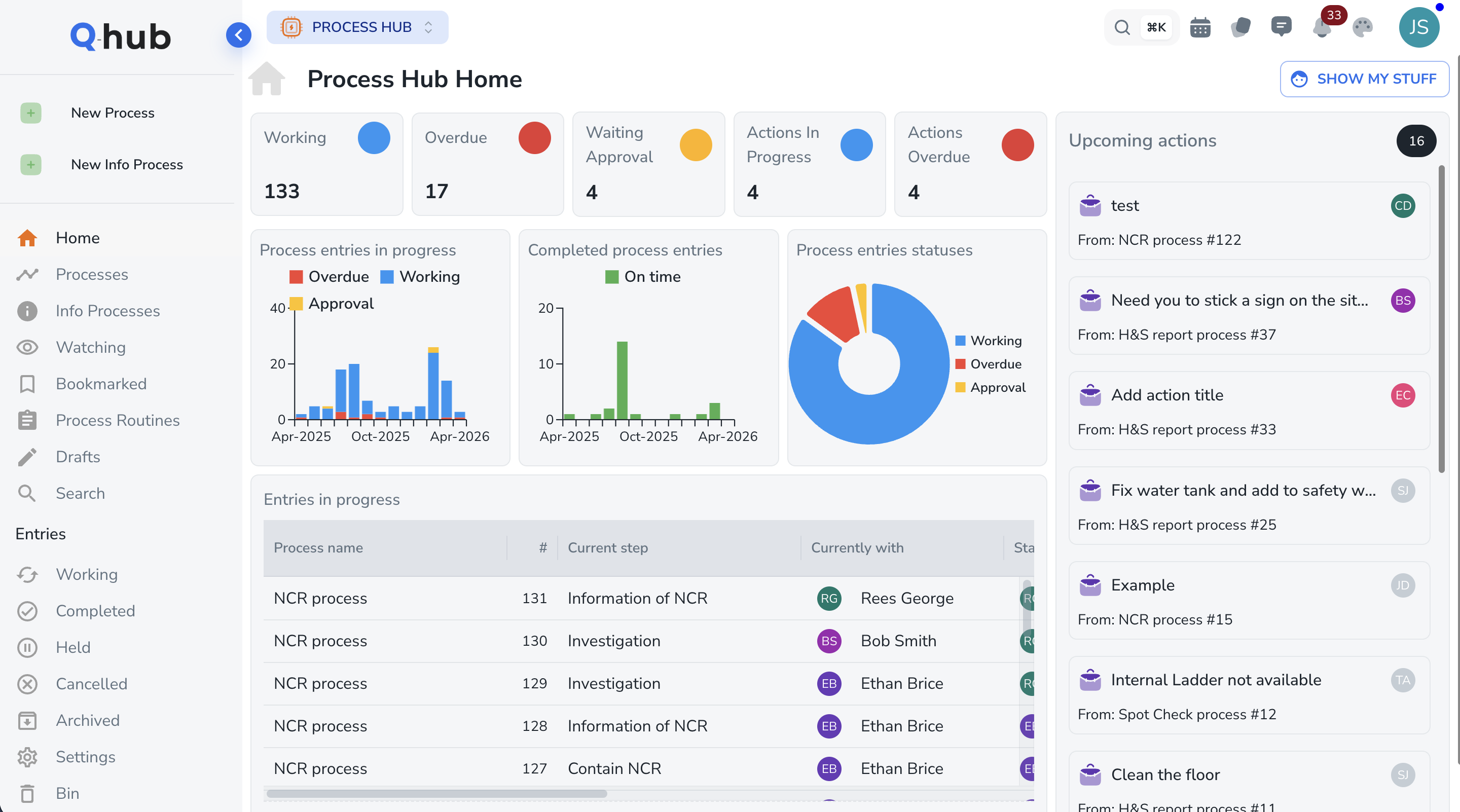
Environmental aspects register Structured aspects and impacts assessment with significance scoring, operational controls mapping, and automatic review scheduling. Every environmental aspect documented and linked to its controls. Legal register and compliance evaluation Maintain a live legal register of all environmental compliance obligations. Schedule periodic compliance evaluations, track permit conditions, and demonstrate ongoing legal compliance to auditors. Environmental KPI dashboards Track energy consumption, water usage, waste volumes, carbon emissions, and recycling rates in real-time dashboards. Demonstrate continual improvement with trend charts auditors can access directly.
Environmental aspects register
Environmental aspects register Structured aspects and impacts assessment with significance scoring, operational controls mapping, and automatic review scheduling. Every environmental aspect documented and linked to its controls.
ISO 14001 certification timeline with Q-Hub
We assess your current environmental management against ISO 14001 requirements, identify significant aspects, and map your compliance obligations. Aspects register, legal register, waste tracking, emissions monitoring, document control, and audit schedules configured in Q-Hub. Your team uses Q-Hub for daily environmental management. Waste records, monitoring data, and compliance evaluations build the evidence base auditors require. External auditor accesses evidence directly in Q-Hub. Aspects register, legal register, monitoring data, and compliance evaluations all available in one place.
Environmental gap analysis
System setup
Implementation and evidence
Certification audit
Turn environmental non-conformances into improvement
ISO 14001 demands you react to environmental non-conformances, take corrective action, determine root causes, and verify effectiveness. Q-Hub automates the entire cycle: environmental incident or permit breach logged, investigation triggered, root cause analysis completed, CAPA raised, corrective action tracked, effectiveness verified. Trend analysis surfaces systemic environmental risks before they become regulatory breaches.
- Structured environmental NCR workflow with root cause tools
- Automated CAPA assignment with escalation and due dates
- Compliance breach tracking and regulatory notification support
- Environmental performance trend analysis and improvement dashboards